Industry News
Cracking the Resin: Inside the Meticulous Art of Repairing GOB LED Modules
SHENZHEN — June 11, 2026 — As fine-pitch LED displays continue to dominate broadcast studios, control rooms, and high-traffic retail environments, Glue-on-Board (GOB) technology has surged to the forefront of the industry. By coating LED modules with a protective layer of epoxy or resin, GOB displays offer unparalleled resistance to impact, dust, and moisture.
However, this same protective shield has created a new headache for AV technicians: when a pixel dies or a module malfunctions, you can’t simply swap out a component. Repairing a GOB LED module requires a delicate, highly specialized process that blends micro-soldering with precision chemistry.
Here is an inside look at how industry professionals are mastering the complex repair of GOB LED modules.
The Anatomy of the Challenge
Unlike traditional SMD (Surface Mount Device) displays, where LED chips are exposed and can be easily reflowed or replaced with a hot air gun, GOB modules encase the LEDs and the PCB (Printed Circuit Board) in a thick, hardened layer of transparent resin.
"The glue does exactly what it’s supposed to do—it makes the screen virtually indestructible from the front," explains a senior display engineer at a leading Shenzhen-based LED manufacturer. "But when a single LED chip fails, that same glue acts as a fortress, preventing access to the solder joints."
The 4-Step Professional Repair Process
Repairing a GOB module is not a job for standard field technicians; it is typically sent back to specialized repair labs. The process generally follows four meticulous steps:
1. Precision Diagnosis
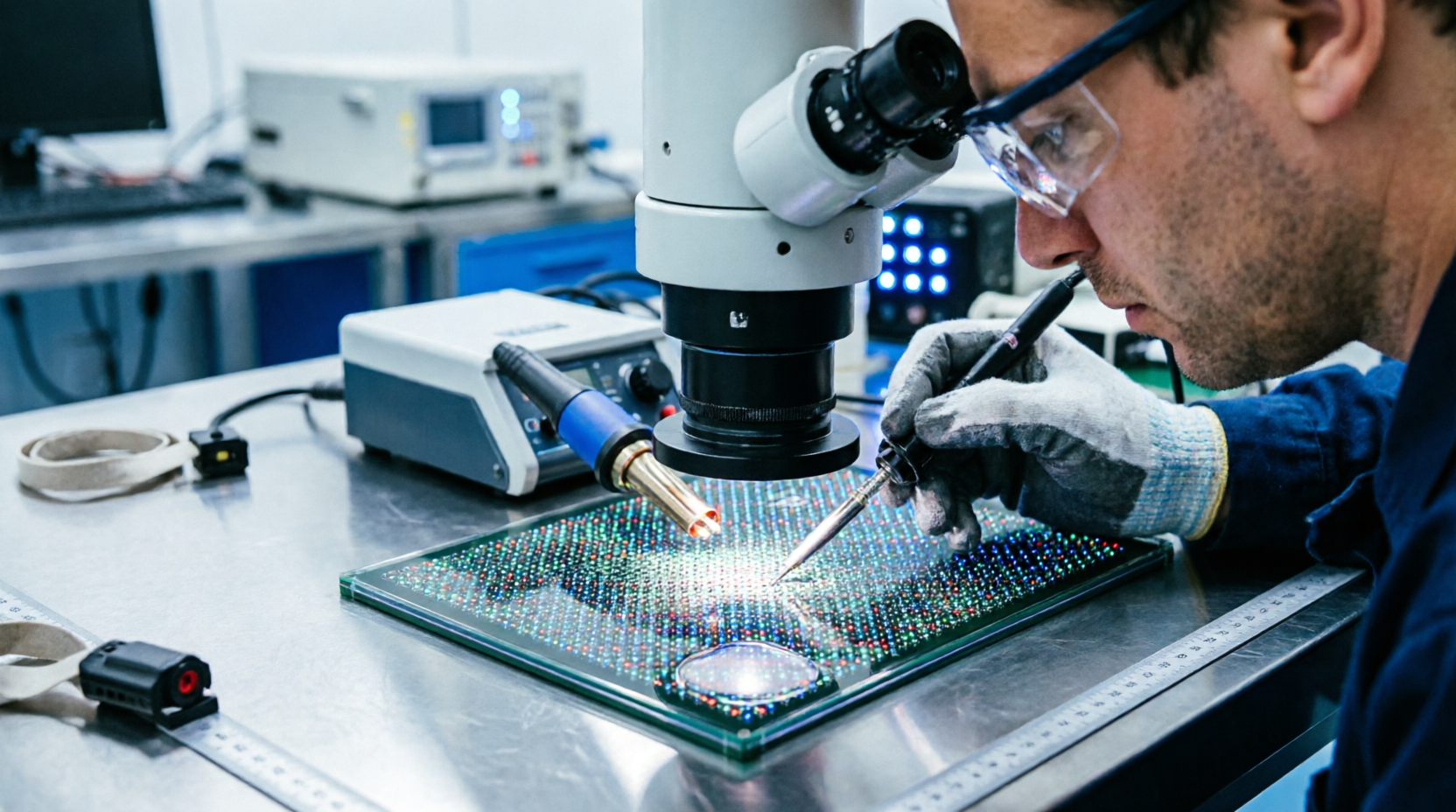
Before any physical work begins, technicians must locate the exact point of failure. Because the resin is transparent, visual inspection under a high-powered microscope is the first step. Technicians use specialized LED testing software to send test patterns (like pure red, green, and blue) to the module to identify dead pixels, stuck pixels, or short circuits. In complex cases, thermal imaging cameras are used to detect micro-shorts that generate excess heat beneath the resin surface.
2. The Delicate Glue Removal (The Critical Step)
This is the most dangerous phase of the repair. Technicians must remove the resin only from the immediate area of the defective LED without damaging the surrounding healthy LEDs, the fragile PCB traces, or the wire bonds.
- Thermal Softening: Technicians often use precision heating platforms to gently soften the epoxy.
- Micro-Scraping: Using customized, ultra-sharp micro-scalpels under a microscope, the technician painstakingly scrapes away the softened resin.
- Laser Ablation: In high-end facilities, automated UV or CO2 laser machines are increasingly being used to vaporize the resin with micron-level accuracy, eliminating the risk of human error.
3. Micro-Soldering the Component
Once the defective LED chip is fully exposed, the actual component replacement begins. Using a micro-hot-air rework station set to precise temperatures, the technician melts the microscopic solder joints to lift the dead LED chip away.
The pads on the PCB are then cleaned and re-tinned with fresh solder paste. A replacement LED chip—matched perfectly for wavelength and brightness—is placed using a vacuum pick-and-place tool and soldered into position.
4. Re-encapsulation and Curing
If the repair stops here, the module will suffer from the "mura effect"—a visible clouding or dark spot where the light refracts differently through the missing resin. To restore the module's optical uniformity and IP65 protection, the repaired area must be re-glued.
- Technicians apply a micro-drop of specialized UV-curable optical resin that perfectly matches the refractive index and hardness of the original factory coating.
- The resin is carefully leveled to ensure the surface remains perfectly flat with the surrounding pixels.
- Finally, the module is placed under a UV curing lamp (or heat chamber, depending on the resin type) to harden the new glue, seamlessly blending the repair back into the display.
The Future of GOB Repair
While the current repair process is highly labor-intensive, the industry is rapidly evolving. Manufacturers are currently testing "thermally reversible" resins that can be liquefied at specific temperatures without damaging the electronics, which would drastically reduce the time it takes to remove the glue. Furthermore, AI-driven optical inspection combined with automated laser repair robots is expected to bring the cost and time of GOB repairs down significantly by 2027.
Until then, the repair of GOB LED modules remains a niche, high-skill craft. For AV integrators and rental houses, the takeaway is clear: investing in high-durability GOB screens reduces daily wear and tear, but when a failure occurs, having a reliable, specialized repair partner is just as critical as the display itself.
Fast Facts: GOB vs. Traditional LED Repair
- Time: Repairing a standard SMD LED takes 2–5 minutes. Repairing a GOB LED takes 30–60 minutes per pixel.
- Skill Level: SMD repair requires basic soldering skills. GOB repair requires certified micro-soldering and optical resin handling expertise.
- Success Rate: When done by a professional lab, GOB repairs boast a 95%+ success rate with zero visual degradation post-repair.